Assalamu’alaikum warahmatullahi wabarakatuh
Every year, we return to the story of Qurban. Ibrahim’s obedience. Ismail’s submission. The knife. The test. The mercy.
We honour it. We repeat it. We teach it.
And quietly, almost unintentionally, we leave someone out.
We forget Sayyidah Hajar.
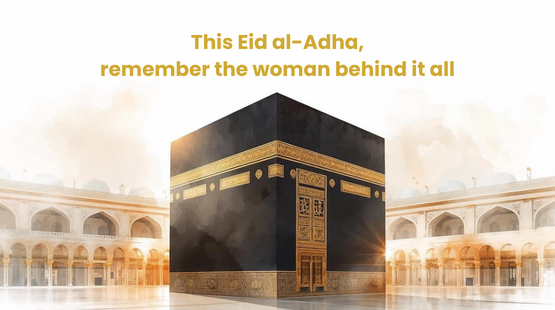
Makkah did not begin with a sacrifice. It began with a mother. She was its foundation.
When Ibrahim left her in the barren valley of Makkah, no water, no people, only dates and a leather jug, she called after him:
"Did Allah command you to do this?"
He said: "Yes."
She stopped. She turned around. She walked back to her son.
Because her iman in Allah was bigger than her fear of the desert, bigger than the loneliness rising in her chest, bigger than every instinct saying this was wrong.
"Then He will not abandon us."
She was not placed in comfort. She was placed in a reality that would break most people: isolation, uncertainty, and a
future that did not exist yet.
When the water ran out, and Ismail cried from thirst, she did not sit in despair.
She ran.
Between Safa and Marwah, back and forth. Scanning the horizon and refusing to stop as long as her child was still breathing.
Seven times.
The distance between Safa and Marwah is about 450 meters one way, that’s roughly 3.15 km total. Not on smooth ground. But in heat, thirst, and urgency. She keeps running.
On the seventh run, she heard something. She stopped. Listened, and then water broke through the earth.
Zamzam
The well that has never run dry in four thousand years. The water billions have drunk since. The miracle that began the city of Makkah. It did not begin with a decree.
It began with a mother running.
And before Ibrahim raised the knife, Shaytan came to Hajar first.
Tried to use the most powerful force in the human heart, a mother's love. To make her refuse. To make her choose her son over her
Lord.
But she did not waver. She rejected him, firmly, completely.
And every year, millions return to that moment. At the Jamarat, stones are cast in
remembrance of that defiance. She stood in that same resistance, unshaken.
Hajar began as a servant with no status, no family, no security.
She became the
mother of a lineage that carried prophethood to Muhammad ﷺ himself, not because of her bloodline, but because of the quality of her iman and the strength of her character.
She was given a desert, a baby, and a promise. She built a civilisation.
This Eid, when you hear Ibrahim's name in the khutbah, hold space for her too.
When you drink Zamzam, remember whose running it’s rewarded.
And if you are in your own desert right now, a season that feels empty, a path that feels abandoned, let her question be yours:
"Did Allah command this?"
If the answer is yes, turn around. Walk back to what He has placed in your hands.
Allah did not abandon her there.
He will not abandon you either.
Wallahu a'lam bissawab.











![ADIL Academic Year 2026: A Muslim's Manual 1 [Complete Guide to Syahadah & Solat]](https://hostedimages-cdn.aweber-static.com/MjY5NDQ0/optimized/367bfb5cafe741e699dc3c3c6cd02cd2.jpeg)