Assalamu’alaikum warahmatullahi wabarakatuh
There is a quiet possibility that visits the last ten nights of Ramadan.
A night that Allah describes in the Quran as better than a thousand months - Surah Al-Qadr (97): 3. More than eighty years of worship, placed into a single
night.
This is the night when the Quran first descended. A night when angels fill the earth, carrying the decrees of Allah. A night filled with peace until the break of dawn.
It is not
only a night of reward. It is a night that reminds us how Allah allows the Ummah to rise.
Because not every believer lives eighty years in worship. Not everyone has the same strength, health, or time. Yet Allah, in His mercy, opens a door where a single sincere night can outweigh an entire lifetime.
Laylat al-Qadr is Allah’s generosity to this Ummah.
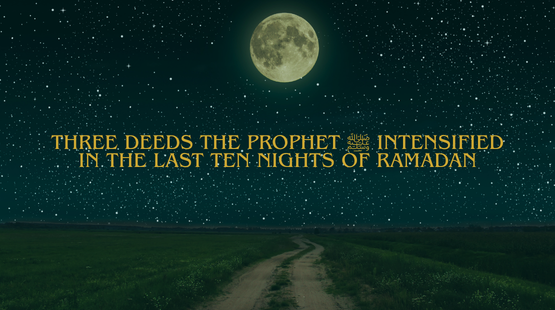
For this reason, the Prophet ﷺ approached the last ten nights differently.
‘Aishah (ra) narrated that when the last ten nights began, the Prophet ﷺ would strive
in worship more than at any other time.
(Sahih Muslim)
These nights invite us to increase the deeds that purify the heart and draw us closer to Allah.
First, deepen the
quality of our fasting.
Fasting is not only about leaving food and drink. It is also about guarding the tongue, the heart, and the way we treat others.
The Prophet ﷺ said:
“If one of you is fasting, let him avoid foul speech and ignorant behaviour. If someone insults him or argues with him, let him say: I am fasting.”
(Sahih al-Bukhari, Sahih Muslim)
The last
nights of Ramadan are an opportunity to refine the spirit of fasting. To soften our words. To bring patience into our homes. To respond with calm when emotions rise.
Second, increase charity.
Zakat is an obligation, but charity reflects gratitude. It is a way of acknowledging that what we hold in our hands was always entrusted to us by Allah.
Many believers choose to give charity throughout the last ten nights, hoping that one of those nights coincides with Laylat al-Qadr.
A small act of generosity on an ordinary night is already beloved to Allah. But when it falls on Laylat al-Qadr, its weight becomes something only Allah can measure.
Third, create moments of
i’tikaf.
The Prophet ﷺ used to observe i’tikaf during the last ten nights of Ramadan, dedicating time for worship and reflection.
I’tikaf is not only about physical seclusion. It is
about creating a space where the heart turns fully to Allah.
A quiet moment with the Quran.
A sincere dua whispered in the night.
A moment of reflection about who we have been, and who we hope to become with Allah’s guidance.
Among the most beloved supplications for these nights is the dua the Prophet ﷺ taught to ‘Aishah (ra):
Allahumma innaka ‘afuwwun tuhibbul ‘afwa fa‘fu ‘anni.
“O Allah, You are Most Forgiving, and You love to
forgive, so forgive me.”
(Sunan al-Tirmidhi)
As these nights pass, we ask Allah to grant us the blessing of witnessing Laylat al-Qadr and to accept whatever small efforts we bring.
May Allah fill these nights with forgiveness, acceptance, and peace. And in a world that often feels uncertain, may He grant the Ummah stability, mercy, and guidance.
Allahumma taqabbal minna siyamana wa qiyamana wa du‘a’ana.
O Allah, accept our fasting, our prayers, and our supplications.
Wallahu a‘lam.

![Supermom Ramadan: Grand Finale of the Blessed Nights [Muslimah Only]](https://hostedimages-cdn.aweber-static.com/MjY5NDQ0/optimized/285c8c45af3945a3bf3ee3e35fd3f688.jpeg)